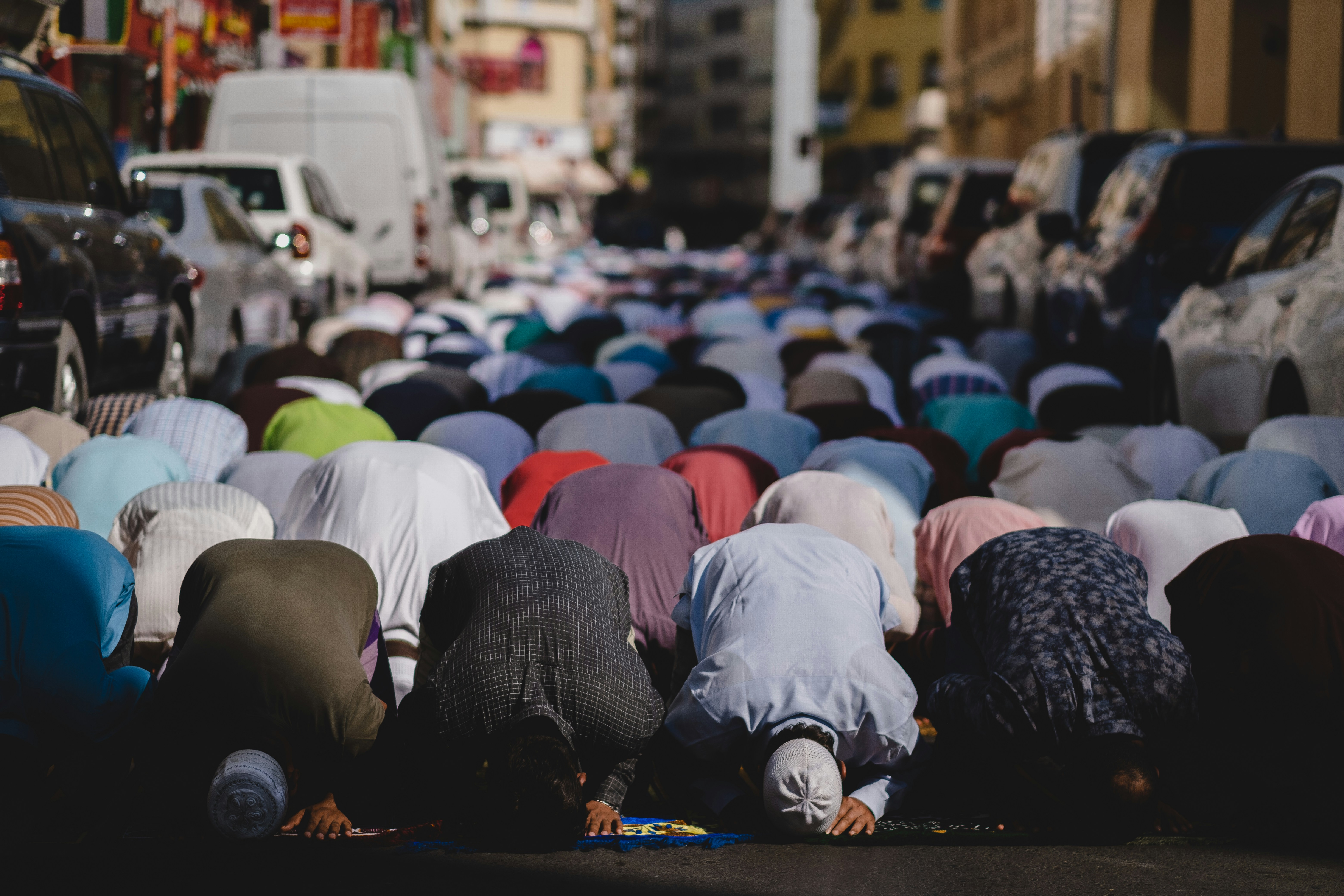
The story of Ishmael can be found in Genesis 16, 17, 21, and 25. He was born to Abraham and Hagar, Sarah’s Egyptian servant. Ishmael was Abraham’s first son and received a promise from the LORD of blessing and multiplication, but he did not inherit the covenant itself.
Scripture portrays Ishmael as the father of twelve tribes who settled in the region between Egypt and Assyria, in northwestern Arabia (Gen.25:13-18). God cared for Ishmael and made him into a great nation, yet the covenant promises of redemption and inheritance continued through Isaac and Jacob.
Later biblical references show that Ishmael’s descendants are active as merchant tribes in the area (Gen.37:25–28), but they never inhabited all of Arabia. The biblical record therefore gives a clear picture: Ishmael was blessed, but he had no part in the covenant line that led to Israel and the Messiah. This distinction is essential if you want to evaluate Islam’s later claim to trace its spiritual or physical heritage back to Ishmael.
And that is what many Muslims do. They claim that the Arab peoples — and even Muhammad himself — are descendants of Ishmael, Abraham’s first son. This connection is often used to present Islam as one of the “Abrahamic” faiths and thereby give it credibility. But when we examine history, a different picture emerges.
How Solid are the Historical Foundations of Early Islam?
The historical foundations of early Islam are the subject of serious scholarly debate. Historians such as Patricia Crone and Michael Cook (Hagarism: The Making of the Islamic World, Cambridge University Press, 1977) and Tom Holland (In the Shadow of the Sword, Doubleday, 2012) argue that much of the traditional Islamic narrative about Muhammad’s life emerged a century or more after his supposed lifetime, raising legitimate questions about the reliability of early Islamic sources.
Some scholars, such as Sven Kalisch, former Professor of Islamic Theology at the University of Münster, went even further — concluding that Muhammad may never have existed at all, given the absence of contemporary evidence and the late formation of Islamic tradition.

The Development of Arab Identity
As I mentioned before, the Bible tells us that Ishmael’s descendants became twelve tribes living in northwestern Arabia, between Egypt and Assyria (Gen.25:13-18). Their territory was specific and limited. It never encompassed the entire Arabian Peninsula. These Ishmaelites became part of the broader Semitic world, but they were not the sole ancestors of all Arab peoples.
Centuries later, the term Arab referred to a much broader mix of tribes that shared similar languages and cultures. The Arab identity we know today developed gradually, through centuries of migration, conquest, and cultural blending. It was not a single genealogical line from Ishmael, but rather a fusion of multiple Semitic peoples who would eventually be identified as Arabs.
Even early Islamic historians recognized this complexity. The most famous among them, Ibn Ishaq, whose Sirat Rasul Allah (Life of the Messenger of Allah, written mid-8th century AD, about 120–130 years after Muhammad’s death) remains a key biography of Islam’s alleged founder. He openly admits uncertainty in tracing Muhammad’s ancestry back to Ishmael. The supposed link was likely constructed later to give Islam a sense of continuity with Abraham — and with it, legitimacy in the eyes of Jews and Christians.
As historian Hugh Kennedy notes in The Prophet and the Age of the Caliphates (Routledge, 2004), there is no credible historical or genealogical evidence that Muhammad was a direct descendant of Ishmael. The connection is a pious legend, not a verifiable fact.

The Deeper Theological Question
Could it be that this uncertain lineage points to a deeper Arab identity crisis — one that compelled Muhammad to insert himself into Abraham’s story? In doing so, Islam replaced YHWH, the covenantal God of Israel, with Allah, a deity who explicitly denies having a Son (Qur’an 4:171; 5:116).
This raises a crucial question: is Islam truly an Abrahamic faith — or falsified history that severs itself from the covenant line?
The Covenant Continues Through Isaac
Scripture is clear: God’s covenant promises continued through Isaac, not Ishmael, and through Jacob, whom God renamed Israel. The Abrahamic blessing flows through this line (Gen. 17:19-21). Yet the good news is that Gentiles — including Arabs — are graciously grafted in and made part of God’s family through faith in Israel’s Messiah, Jesus (Rom. 11:17-24).
They don’t replace Israel; they join her in the redemptive story. The God of Abraham invites all nations to share in his covenant, not by bloodline, but through allegiance to his Son.
One Restored People
In the end, Arabs, like all nations, can belong to God’s covenant family only through faith in Jesus the Messiah — the Son of God who unites Jew and Gentile, Israelite and Arab, into one restored people and one eternal kingdom. As God said to Abram
“In you all the families of the earth shall be blessed.”
(Genesis 12:3)
May we keep praying for our Muslim friends and neighbors that they will see the truth and embrace the salvation that can only be found in Messiah Jesus!

Scholarly Note & Recommended Reading
While the Qur’an frequently invokes Abraham to try to establish Islam’s credibility, the historical and textual evidence points to a post-biblical reconstruction of the patriarchal story. Scholars such as Kaiser, Kennedy, and Durie show that Islam’s claim to be “Abrahamic” is ideological rather than genealogical, reshaping Abraham’s covenant into a narrative detached from Israel’s redemptive line.
I can recommend the following resources to study this further:
- Walter C. Kaiser Jr., The Promise-Plan of God (Zondervan, 2008).
— A biblical study of God’s covenant purposes through Abraham, Isaac, and Jacob. - Ibn Ishaq / Ibn Hisham, Sirat Rasul Allah (trans. A. Guillaume, The Life of Muhammad, Oxford University Press, 1955).
— The earliest Islamic biography, acknowledging uncertainty about Muhammad’s genealogy. - Hugh Kennedy, The Prophet and the Age of the Caliphates (Routledge, 2004).
— A reliable overview of early Islamic history, noting the absence of proof for Ishmaelite descent. - Patricia Crone and Michael Cook, Hagarism: The Making of the Islamic World (Cambridge University Press, 1977).
— A groundbreaking yet controversial study arguing that Islam arose from a Jewish-Christian sectarian milieu and that the traditional Islamic narrative was constructed much later. - Tom Holland, In the Shadow of the Sword: The Battle for Global Empire and the End of the Ancient World (Doubleday, 2012).
— A vivid historical reconstruction showing how Islam emerged within the collapsing world of Late Antiquity, questioning many of the traditional assumptions about Muhammad and early Mecca. - Mark Durie, The Qur’an and Its Biblical Reflexes: Investigations into the Genesis of a Religion (Lexington Books, 2020).
— A scholarly yet accessible work comparing the Qur’an’s version of Abraham’s story with the biblical account. - Sven Kalisch, various essays and interviews (see e.g., “Der Prophet Mohammed hat nie existiert,” Der Spiegel, 2008).
— A German Islamic scholar who concluded that Muhammad may never have existed as a historical figure, based on the absence of contemporary evidence and the late formation of Islamic tradition. - Nabeel Qureshi, No God but One: Allah or Jesus? (Zondervan, 2016).
— A powerful exploration by a former Muslim who found the truth of the gospel through study and encounter with Christ.
Featured image by Levi Meir Clancy on Unsplash.

Leave a Reply