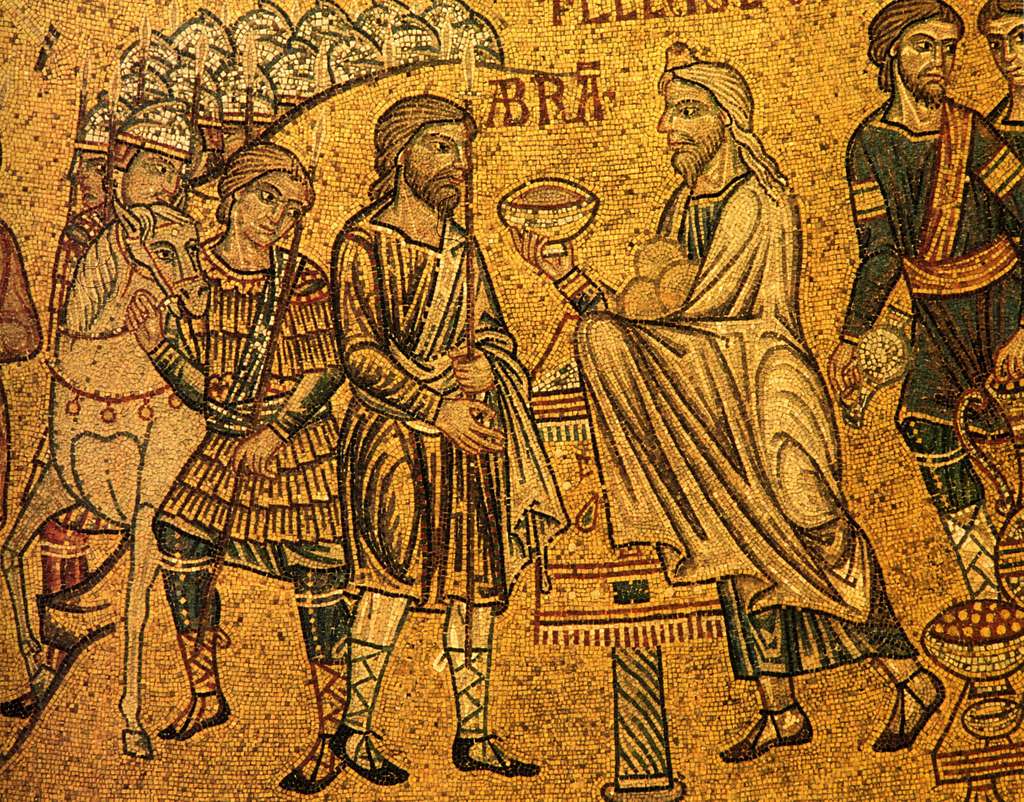
Melchizedek appears only briefly in Genesis 14. He is called the “king of Salem” and “priest of God Most High.” He steps into the story without an introduction: no genealogy, no background, no mention of his death. And he disappears as sudden as he arrived. He is, without question, one of the most mysterious figures in Scripture.
Yet his brief appearance is filled with significance. Psalm 110 foretells that the coming Messiah will be “a priest forever, after the order of Melchizedek,” and the book of Hebrews later explains that this priesthood is eternal and superior to the Levitical priesthood because it rests not on ancestry but on divine appointment.
King of Righteousness, King of Peace
Hebrews 7 describes Melchizedek as “without father or mother, without beginning of days or end of life,” language that suggests he is more than an ordinary human priest. His name (Melchizedek = king of righteousness) and his title (melek salem = King of Peace) point to qualities that only the Messiah fully embodies. Like the Angel of YHWH who appears throughout the Old Testament, Melchizedek mediates divine blessing, speaks as God, and yet remains distinct from God the Father in heaven.
A Pre-Incarnate Appearance of Jesus
For this reason, many Bible scholars, including early church fathers and modern theologians, identify Melchizedek as a pre-incarnate appearance of Jesus, the eternal Priest-King. When he meets Abram and offers him bread and wine, he foreshadows the Messiah’s ultimate priestly act: offering his own body and blood for the forgiveness of humanity. Abram’s response, giving a tenth of all he had (a tithe), was an act of worship and surrender to the One who had blessed him.
The same One who met Abraham now reigns from heaven. He intercedes for his people and will return to establish his kingdom of righteousness and peace forever.
Is your life surrendered to this Priest-King called Jesus? Have you entrusted not only your heart but everything you possess to him, as Abram did?
Scholarly Note
The figure of Melchizedek has long invited theological reflection. The writer of Hebrews develops the typological link between Melchizedek and Christ to demonstrate the superiority and eternality of Jesus’ priesthood (Heb.7:1-17).
Scholars such as F.F. Bruce and Meredith G. Kline argue that Melchizedek serves as a Christophany – a preincarnate manifestation of the Son of God – given his timeless attributes and dual role as king and priest.¹ Others, like Craig R. Koester, interpret him typologically rather than ontologically, as a literary foreshadowing of the Messiah’s priesthood.² In either case, the Melchizedek narrative reveals that God’s redemptive plan was always centered on a divine Priest-King who brings righteousness and peace.
¹ F.F. Bruce, The Epistle to the Hebrews (NICNT; Grand Rapids: Eerdmans, 1990), 169–174; Meredith G. Kline, Kingdom Prologue (Eugene, OR: Wipf & Stock, 2006), 218–220.
² Craig R. Koester, Hebrews: A New Translation with Introduction and Commentary (AB 36; New York: Doubleday, 2001), 345–347.
Featured image is from a mosaic in the Basilica di San Marco

Leave a Reply