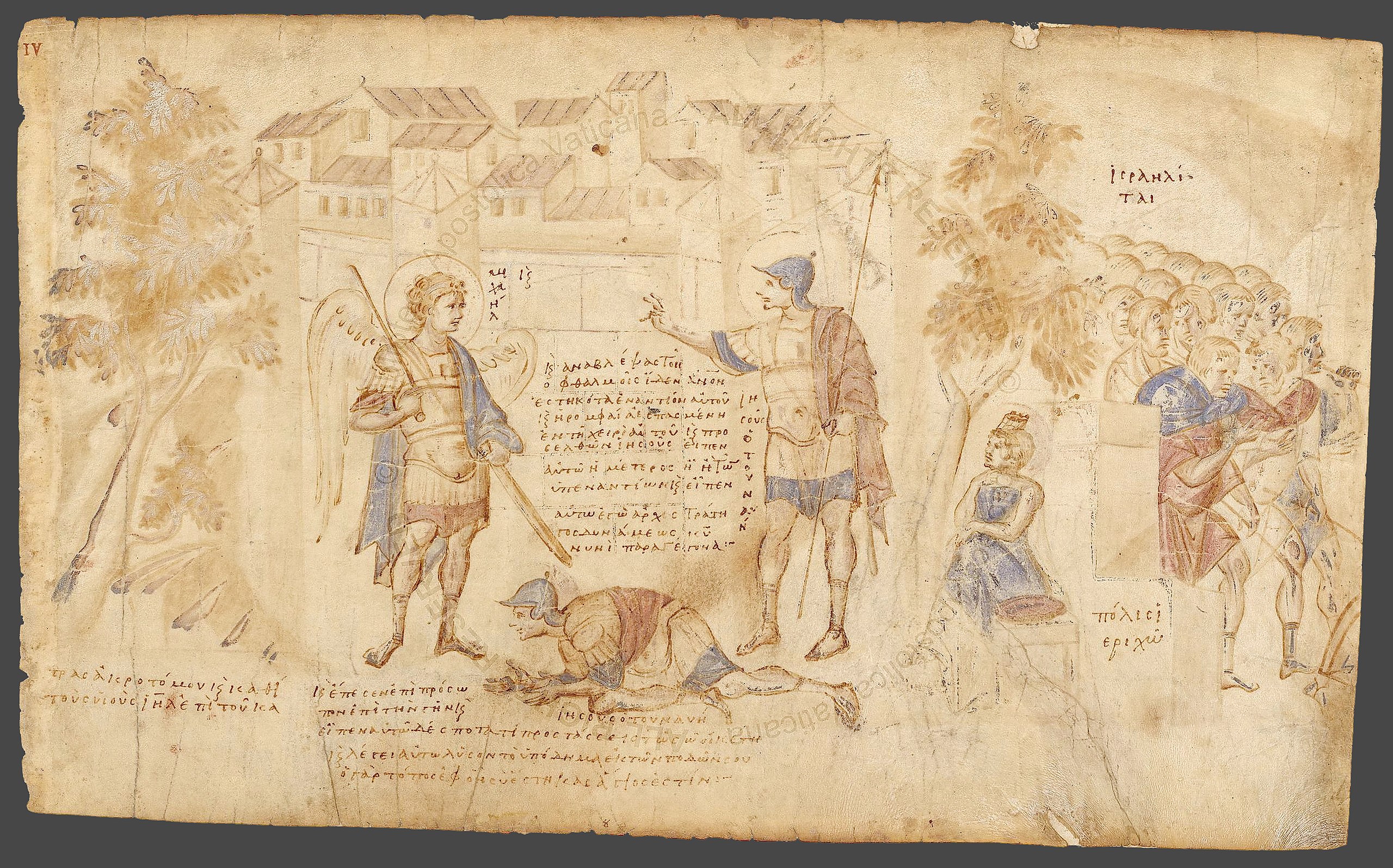
One of the most intriguing passages of scripture in my opinion is found in Joshua 5. Right after crossing over the Jordan River from the east into Canaan, the first stop for Joshua and the children of Israel is the city of Jericho. In Joshua 4 YHWH gives Israel instructions on how to conquer this city. That is, if you think circling around the city for seven days and shouting from the top of your lungs is conquest!
So now we find ourselves in Joshua 5, and here Joshua has an encounter with the commander of YHWH’s armies:
“When Joshua was by Jericho, he lifted up his eyes and looked, and behold, a man was standing before him with his drawn sword in his hand.
And Joshua went to him and said to him, “Are you for us, or for our adversaries?”
And he said, “No; but I am the commander of the army of the LORD. Now I have come.”
And Joshua fell on his face to the earth and worshiped and said to him, “What does my lord say to his servant?”
And the commander of the LORD’s army said to Joshua, “Take off your sandals from your feet, for the place where you are standing is holy.”
And Joshua did so.”
(Joshua 5:13-15 ESV)
I understand Joshua’s response. Here he is standing eye to eye with this man with a drawn sword. What is he going to do? Does he want to kill me? It doesn’t look like he is coming in peace!
So Joshua asks him the obvious question: “Are you for us, or for our adversaries“?
Do you notice the interesting answer the man gives? The man says: “No.” Please, sir, this is not a yes and no question! Are you for us or for them, for the people of Jericho?
Now Joshua finds out who the man is: “I am the commander of the army of the LORD.” Basically, instead of Joshua trying to get him on Israel’s side, the message to Joshua is that he needs to be on YHWH’s side.
Who is this commander?
Who is the commander of YHWH’s armies? At first you may think this is an angel or so. But why did Joshua bow down before him? Why did the commander say the very thing as YHWH said when he spoke to Moses from the burning bush: “Take off your sandals because the ground you are standing on is holy”? Joshua here had his own burning bush experience, just like his spiritual father, Moses had!
(article continues below image)

So who is this commander? Well, chapter 5 doesn’t really give too many clues, besides the fact that Joshua “fell on his face to the earth and worshiped“, and that the commander said that the ground Joshua was standing on was holy. It does make it quite probable that the commander was somehow divine. If he was just a man or just an angel, he would have told Joshua to get back on his feet and stop worshiping him.
But there is more to the story!
Could the commander be YHWH himself?
The chapter divisions in the Bible are often confusing. Remember, they are not inspired, just like the verse division is not inspired! The Old Testament, or Tanakh as the Jews call it, consisted of scrolls and the text just kept going.
So what’s in chapter 6 belongs to chapter 5. And there you see that Joshua was speaking with the LORD, to YHWH himself, or with a manifestation of God he could process with his human senses:
“…the LORD said to Joshua…”
(Joshua 6:2 ESV)
In other passages in the Old Testament, this visible appearance of YHWH is most often referred to as the Angel of YHWH.
Joshua here was speaking to the Angel of YHWH, who is YHWH himself. This Angel of YHWH took on human flesh in the New Testament. We know him as Jesus, or Yeshua in Hebrew.
Conclusion
The army commander is YHWH himself, and I dare to say that it is Jesus before his incarnation. Why? Because:
- Joshua bowed down in worship;
- the ground YHWH was standing on was holy, because YHWH’s presence made it holy;
- because the text specifically tells us that it is YHWH that Joshua was speaking to.
Interestingly enough, Joshua’s name in Hebrew is Yehoshua. This is the very same name as Yeshua. Both names mean YHWH saves. Joshua had to fight the battle on behalf of Jesus, but Jesus would give the victory, Jesus would give salvation.
Even Rahab experienced YHWH’s salvation. Everything had to be destroyed in the city of Jericho. Everything was “kherem” (devoted to destruction), except for the silver, gold, iron and bronze. Only Rahab and her family would be saved because of what they had done for Israel.
YHWH’s salvation is for both Israel and the Jews, and for non-Jews, such as Rahab… and you and me! He gives salvation! He gives victory!
Featured image is from the Joshua Roll: “Joshua and the Angel”, Sheet 12, Rome, 10th century. Height, 32.4 cm. Biblioteca Apostolica Vaticana.


Leave a Reply